
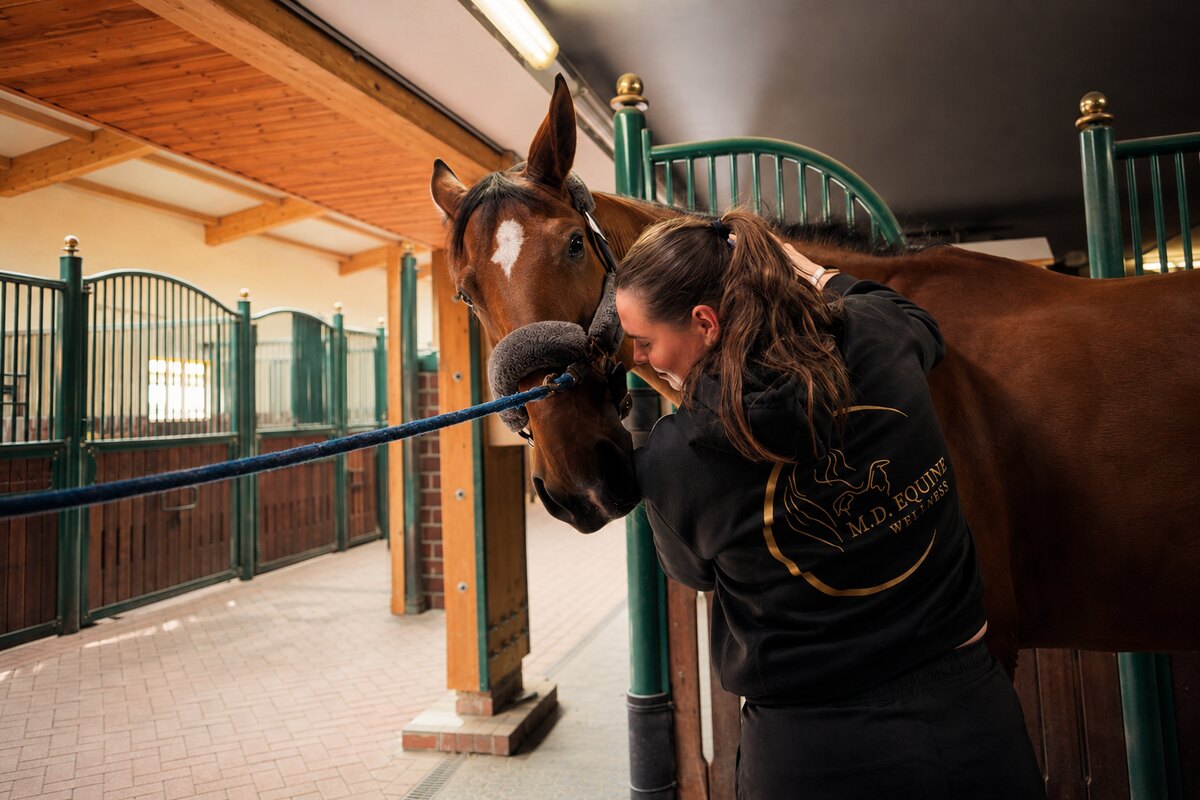
Focused light. Practical recovery support.
Red light therapy, also called photobiomodulation (PBM), uses specific wavelengths of red and near-infrared light. At MD Equine Wellness we use it as a focused addition to a horse’s recovery and everyday care routine.
Where it can be used
The B4A PBM device combines red and near-infrared light, allowing local application over both superficial and somewhat deeper structures. This makes it useful when we want to focus on a specific region rather than treat the whole body.
Muscles
Focused support for local muscle fatigue, tight areas, post-work soreness and regions that repeatedly carry more load.
Tendons & ligaments
Useful as local support during tendon or ligament rehabilitation, after heavy loading and when a veterinarian has identified a specific structure to monitor.
Joints
Focused application around joints when stiffness, age, repeated workload or rehabilitation makes local support useful.
Skin & superficial tissue
A practical option for superficial tissue recovery, scar areas and selected wound-recovery situations once appropriate veterinary care is in place.
When riders use Red Light
Red Light becomes especially useful when the area is specific and easy to target. Common reasons to reach for it include:
After demanding work
Local muscle fatigue, tight areas and targeted post-training recovery.
During rehabilitation
Focused support around selected tendon, ligament, joint or soft-tissue regions.
Scar and superficial tissue
Useful when the goal is to work precisely over a small surface-near area.
Older or heavily worked horses
Targeted support can be added exactly where a horse repeatedly needs extra attention.
How PBM works
Photobiomodulation describes how cells absorb specific wavelengths of light and respond biologically. PBM research focuses on mitochondrial activity, cellular energy production and signalling processes involved in tissue regulation and recovery.
Light is absorbed
Red and near-infrared wavelengths interact with light-sensitive structures in the cell.
Cellular response
Research associates PBM with changes in ATP production, oxidative signalling and cellular regulation.
Used as supportive care
We use it as one tool within a wider recovery plan, not as a replacement for veterinary diagnosis or treatment.
Why this device
The B4A PBM is a compact Austrian-made device designed for horses. Its combination of red and near-infrared wavelengths gives us a practical way to work locally and precisely.
red and near-infrared together
6 red + 8 near-infrared
optional pulse mode
practical around horses
PBM and PEMF are not the same
PEMF uses pulsed electromagnetic fields and can be applied over larger areas of the body. PBM uses light and is more local. I do not present one as a replacement for the other: the choice depends on the horse, the area we want to support and the wider care plan.
The B4A PBM is a wellness product, not a medical device. For a diagnosed condition or injury, veterinary guidance remains essential.
Ask about Red Light Therapy